
Reviewed · WALKING TOURS
Guatemala city Walking Tour and public bus
Guatemala City rewards curious walkers. This $30 tour links the city’s grand civic buildings, churches, markets, and plazas with public bus travel, giving you a useful introduction to Guatemala City in about two to two and a half hours. I like the small-group limit of 15 people and the fact that the bus fare is included. You get more than a string of photo stops: you also see how residents move between parts of the city.
I also like the clear beginning and ending points, starting at the Westin Camino Real and finishing at Plaza de la Constitución. The main caution is the pace. Some of the listed stop times are generous, and one past guest found the tour slow, while others appreciated the extra explanations. If you want a fast checklist of landmarks, this may feel leisurely. If you want context from a local guide such as Armando or Fidencio, the slower rhythm can work in your favor.
In This Review
- Key points at a glance
- Starting at the Westin and riding like a local
- Centro Cívico and Guatemala City’s modern power
- The National Typography building and Guatemala’s print story
- El Calvario and San Francisco Church
- The Post and Telegraph Palace
- Casa Ibargüen and the restored historic center
- Plaza de la Constitución, the city’s great public room
- The Metropolitan Cathedral and Central Market
- Finishing with coffee on Paseo de la Sexta
- What the $30 price really buys you
- Who will enjoy this Guatemala City tour?
- Should you book it?
- FAQ
- How much does the Guatemala City walking tour cost?
- How long does the tour last?
- Where does the tour begin?
- What time does the tour start?
- Where does the tour end?
- Is public transportation included?
- Is lunch included?
- Is coffee included?
- How many people can join the tour?
- Can the tour be canceled for a full refund?
Key points at a glance
- Public bus fare is included, so you can cross the city in a practical local way instead of staying inside a sightseeing vehicle.
- The route begins at the Westin Camino Real and ends at Plaza de la Constitución, making both ends easy to find.
- Zone 1 receives the main attention, with churches, government buildings, the Central Market, and historic streets.
- Armando and Fidencio have earned strong praise for clear English, friendly service, local knowledge, and patience with questions.
- The Central Market is a major highlight, with time for a local-style lunch if you choose to pay for it separately.
- The $30 price is fair for an introduction, especially with transportation included, but coffee, lunch, and entry fees are extra.
Starting at the Westin and riding like a local
The meeting point is outside the Westin Camino Real on Avenida La Reforma, with departure at 10:30 a.m. That gives you a simple start in a familiar hotel area, rather than asking you to find an obscure corner of the historic center.
From there, the tour uses public transportation to reach the central districts. The bus fare is included, which is a small but useful benefit. More important, it gives the outing a real city feel. You are not sealed away from traffic and daily life, and you get a practical look at how Guatemala City connects its business, civic, and historic areas.
The group can reach 15 people, though a smaller booking may turn into a private-feeling experience. One couple found themselves alone with Armando, while a family with a young child had Fidencio to themselves. That matters because the route has many stops and questions can easily get lost in a large crowd.
The public bus element also means you should wear comfortable shoes and bring water. A past guest found the heat noticeable and recommended a hat, sunscreen, and water. Those are sensible choices for any walking route in Guatemala City, especially one that moves between open plazas and paved streets.
More City Tours in Guatemala City
- PRIVATE SHUTTLE From Airport/Guate City to ANTIGUA or Vice-versa
★ 5.0 · 120 reviews - Lake Atitlán Sightseeing Cruise with Transport from Guatemala City
★ 4.5 · 87 reviews - Antigua Guatemala Full-Day Shared City Tour
★ 5.0 · 84 reviews
Centro Cívico and Guatemala City’s modern power
The first main stop is Estación Centro Cívico, where the route takes in several large civic and financial buildings. You see City Hall, the Banco de Guatemala, Banco Crédito Hipotecario Nacional, and Social Security offices.
This is a useful opening because it puts Guatemala City’s institutions in front of you before the tour turns toward colonial churches and traditional markets. The buildings are not simply background scenery. They show the city’s modern government and financial center, and a guide can help explain how these offices fit into the country’s public structure.
Nearby, the tour also points out the cultural center linked to the engineer Recinos, who was responsible for monitoring, construction, and creative development of the Guatemalan Cultural Center Miguel Ángel Asturias. The supplied itinerary gives little time detail for this particular point, so expect an exterior explanation rather than a full museum visit.
No admission tickets are included at the stops. That is not a major issue here because much of the value comes from walking, orientation, and commentary outside the buildings. Still, do not expect an attraction-based tour with extensive interior visits.
The National Typography building and Guatemala’s print story
At the Dirección General del Diario de Centro América y Tipografía Nacional, your guide explains the history of Guatemala’s national printing operation.
The first National Typography building operated from 1894 to 1918 on what was then called Hospital Street, at 2nd South Avenue and 10th Street. In 1935, President Jorge Ubico ordered construction of a new building for the National Typography.
This stop gives the route a useful change of subject. You are not only looking at churches and government facades. You are also hearing about newspapers, official printing, and the machinery of public communication.
The scheduled time is about 20 minutes, enough for an exterior look and a proper explanation. If your guide is Armando, expect plenty of city context delivered in English. His background includes work in Guatemala City and previous service as a firefighter, which helped one couple receive explanations about the city’s government, architecture, and daily life.
El Calvario and San Francisco Church
The Parroquia Rectoral Nuestra Señora de los Remedios, commonly called El Calvario, has had an unsettled history. The original church stood on Cerro del Cielito at the end of Sixth Avenue in the historic center. In 1936, it became the National Museum of History, and it was later demolished to make way for an expanded road.
That short stop is valuable because it shows that historic buildings are not always preserved. Streets, traffic, government decisions, and urban growth can change the city’s older core. The tour gives you a quick look at the church and its place in the city’s past, with roughly 10 minutes scheduled.
The next stop, Iglesia San Francisco, remains part of the historic center and belongs to the conventual Franciscan friars. It is connected administratively with the parish of Our Lady of Remedies.
Neither church includes an admission ticket. The visit is best understood as a guided exterior stop, unless your guide advises otherwise on the day. Ten minutes is enough to see the setting and hear the main points, but not enough for a long architectural study or quiet personal visit.
More Walking Tours in Guatemala City:
- Guatemala City: Walking Tour
★ 4.9 · 42 reviews - Antigua Guatemala: City Highlights Guided Walking Tour
★ 5.0 · 462 reviews - Antigua Guatemala: Street Food Walking Tour with Tastings
★ 4.8 · 87 reviews - La Antigua Horror Stories Night Walking Tour
★ 4.9 · 74 reviews
The Post and Telegraph Palace
The General Directorate of Posts and Telegraphs occupies a building formerly known as the Palacio de Comunicaciones. Rafael Pérez de León and Enrique Riera designed it during the government of Jorge Ubico.
Construction began in 1938. The first phase opened two years later as part of the president’s birthday celebration, and two more phases followed during the next five years. The result is one of the route’s clearest examples of government-era architecture tied to communications and state power.
You have about 15 minutes here. That makes it a good stop for anyone who enjoys buildings with a political and civic story, but it may feel brief if architecture is your main reason for joining. The guide’s explanation is likely to be more useful than the short photo pause alone.
Casa Ibargüen and the restored historic center
Casa Ibargüen receives the longest scheduled stop, about 30 minutes. The building was once the Beltranena palace, built in 1778, and now serves as the headquarters of the Foundation of the Historic Capital Center.
This is where the tour can slow down and connect individual buildings to the broader work of preserving Zone 1. The building’s former palace role gives you a sense of the area’s older social order, while its current use shows how historic structures can be adapted for present-day cultural and civic purposes.
The extra time should appeal to you if you prefer explanation over rapid sightseeing. It may also help balance the earlier 10-minute church stops. As no admission is included, ask your guide what parts of the building are open during your visit rather than assuming you will enter.
Plaza de la Constitución, the city’s great public room
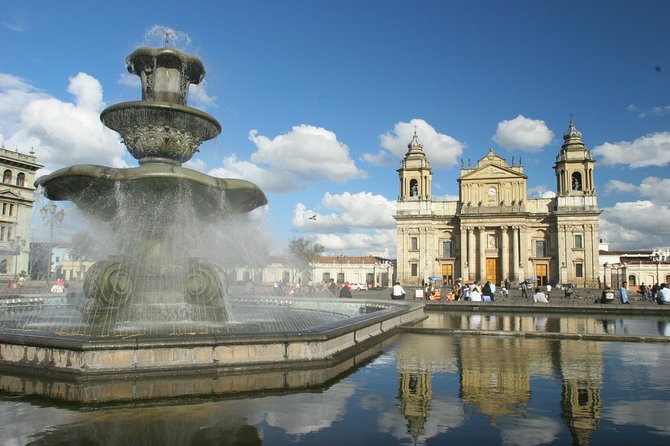
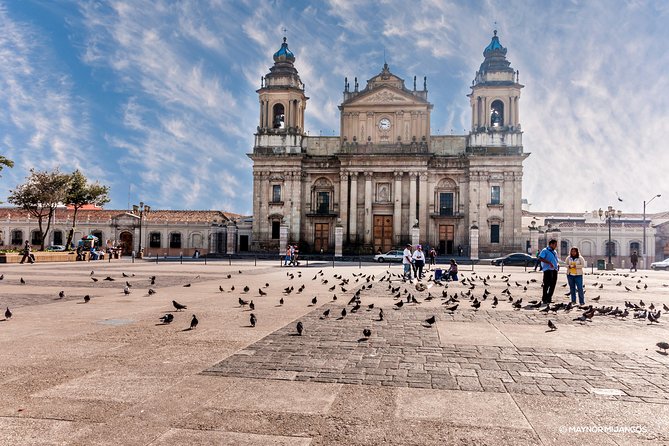
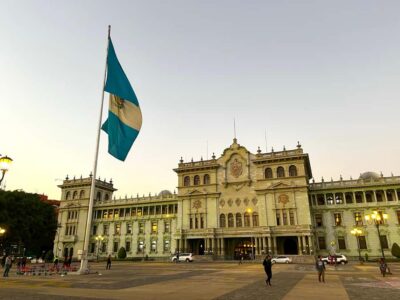
The route then reaches Plaza de la Constitución, also called Central Park. This is the geographic and civic heart of Guatemala City’s historic center.
The square is framed by the National Palace to the north, the Metropolitan Cathedral to the east, the Portal of Commerce to the south, and Centennial Park and the National Library to the west. The main entrance of the National Palace is also considered kilometer zero for roads across Guatemala.
The plaza has hosted Independence Day celebrations, parades, concerts, speeches, and political demonstrations. It is also linked with the Huelga de Todos los Dolores, the student parade connected with the University of San Carlos. This makes the square more than a pleasant open space. It is a place where Guatemala’s public life has repeatedly taken shape.
The planned visit lasts about 15 minutes, but the location is also the tour’s final point. After the guided portion ends, you have your own time to walk around the plaza or continue exploring the historic center. That flexible finish is one of the route’s best practical features.
The Metropolitan Cathedral and Central Market
The Catedral Metropolitana de Santiago de Guatemala faces the plaza and has endured more than two centuries of political and natural upheaval. The cathedral has experienced two major earthquakes, Guatemala’s independence, and a revolution. A Carrara marble altar was installed on July 23, 1860.
The scheduled stop is about 15 minutes. That is enough for a clear introduction and photographs, but you should not expect a full architectural tour. If the cathedral is open and you want a longer visit, you may need to return after the guided route.
Next comes Mercado Central, one of the most useful stops for understanding everyday Guatemala City. Its origins involve a former cemetery, an abandoned square, a half-destroyed chapel, and a plan by Dr. Mariano Gálvez to create a proper public market.
The project faced serious obstacles. Authorities had to move the cemetery, and the early removal of recently buried bodies was blamed for an outbreak of cholera. Church officials also opposed the plan because the area was considered sacred and belonged to the Church.
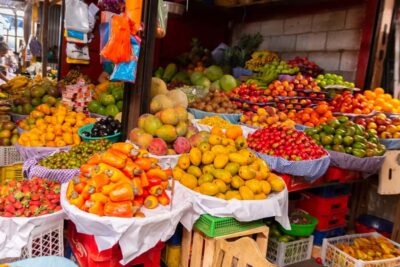
The market visit lasts about 20 minutes. One past guest called it one of the best market experiences in Latin America and praised the chance to eat lunch there like a local. Lunch is not included, so bring extra money if you want to make a meal of this stop. Even if you only walk through, the market gives the tour a welcome shift from official buildings to food, commerce, and ordinary city life.
Finishing with coffee on Paseo de la Sexta
The final stop is San Martín in the Centro Histórico, located in the old Pavón House on Paseo de la Sexta and 10th Street. The building was revitalized for a San Martín bakery and restaurant.
The plan is to finish with a cup of Guatemala coffee. Coffee and tea are not included, so you pay separately for anything you order. This is a pleasant ending because it gives you a place to sit, ask final questions, and let the morning settle before continuing on your own.
The scheduled 30 minutes here may feel generous if you only want a quick drink. It works better if you enjoy a relaxed finish, want to order food, or need a pause after the walking and bus ride. The route’s advertised duration is two to two and a half hours, but the stop schedule is quite full, so the actual rhythm may depend on traffic, group size, and how much discussion takes place.
What the $30 price really buys you
At $30 per person, this is not the cheapest way to stroll through Guatemala City. You could walk around Central Park and several nearby streets without paying for a guide. The price makes more sense when you consider the public bus fare, the route planning, and the amount of background packed into a short morning.
You are paying for a guide who connects separate sights into one story. The city hall, typography building, churches, post office, cathedral, market, and historic residences can seem unrelated when visited alone. A guide gives you a reason for each stop and helps you move between districts without having to plan the route yourself.
The strongest value appears when the group is small. A 15-person maximum is reasonable, but a private or nearly private departure gives you far more room for questions. Armando and Fidencio have both been praised for friendly service, clear English, patience, and local insight. That personal quality is central to the experience.
The exclusions are simple: coffee, tea, lunch, and admission tickets are extra. Since the route is mainly outdoors, those costs are easy to control. You can keep the total near the advertised price or spend more at the market and San Martín.
Who will enjoy this Guatemala City tour?
I would recommend it to you if this is your first time in Guatemala City and you want an organized introduction to Zone 1. It is also a good fit if you want to understand the city’s government, architecture, religious sites, and markets in one compact outing.
Families can manage it, based on the experience of a family who joined with a small child and found Fidencio patient and welcoming. Still, expect walking, heat, and public transportation rather than a private vehicle or a gentle sightseeing bus.
You will probably like it if you enjoy local transport, city history, and practical orientation. You may be less happy if you want every stop handled quickly or if you prefer long interior visits. One past guest felt the route was too slow and believed it could have taken half the time. That is a fair warning, especially because the tour includes many explanations and several planned pauses.
Wear good walking shoes, carry water, and use sunscreen and a hat. Plan to pay separately for lunch or coffee if you want either one. The tour ends at Plaza de la Constitución, and the guide can point you toward the Transmetro and explain where to get off for the hotel area.
Should you book it?
Book this tour if you want a human introduction to Guatemala City, especially one that uses public transportation and includes the Central Market. The 4.8 rating from 63 reviews and 97 percent recommendation rate match the main strengths: friendly guides, clear English, useful city context, and a route that covers a lot in half a day.
Skip it if you want a quick, tightly timed photo tour or a route built around museum admission. The pace may be too slow for you, and most stops are exterior visits. For first-time visitors, families, and anyone curious about how the historic center connects to modern city life, the $30 cost is a sensible investment.
Free cancellation is available until 24 hours before the 10:30 a.m. start. The tour also depends on good weather and a minimum number of participants, so a cancellation for either reason brings an offer of another date or a full refund.
FAQ
How much does the Guatemala City walking tour cost?
The tour costs $30 per person.
How long does the tour last?
The stated duration is approximately two hours to two and a half hours.
Where does the tour begin?
It begins at the Westin Camino Real on Avenida La Reforma in Guatemala City.
What time does the tour start?
The tour starts at 10:30 a.m.
Where does the tour end?
It ends at Plaza de la Constitución in Guatemala City.
Is public transportation included?
Yes. Public transportation, including the public bus fare used during the experience, is included.
Is lunch included?
No. Lunch is not included, though you may choose to eat at the Central Market.
Is coffee included?
No. Coffee and tea are not included. The final stop is San Martín, where you can purchase a drink separately.
How many people can join the tour?
The maximum group size is 15 people.
Can the tour be canceled for a full refund?
Yes. You can cancel at least 24 hours before the local start time for a full refund. Poor weather or failure to reach the minimum number of participants can also lead to another date or a full refund.
Recently added around Guatemala City
- Hobbitenango and Antigua Tour: From Guatemala City★ 4.2 · 10 reviews
- Pacaya Volcano Tour & Hot Springs from Guatemala City★ 3.9 · 11 reviews
- Guatemala City Highlights Shared Tour★ 4.6 · 14 reviews
- Iximché: Archaeological Site from Guatemala City★ 4.8 · 4 reviews
- From Guatemala City Hobbitenango Day Tour★ 4.5 · 12 reviews
- From Guatemala City: Lake Atitlan Full-Day Tour★ 4.2 · 23 reviews
- Combo Tour: Colonial Antigua & Guatemala City Explorer Tour★ 3.9 · 24 reviews
- From Guatemala City Semuc Champey in one day.★ 4.0 · 26 reviews
Walking Tours, compared.
Browse the lists this tour appears in